
Differential scanning calorimetry (DSC)
As one of the most important methods for thermal analysis, using differential scanning calorimetry (DSC) it is possible to characterise not only the thermal characteristics of a sample, the temperature at which certain phase transitions of a substance occur can also be determined.
Table of contents
- What is Dynamic Differential Calorimetry (DSC)?
- Which information does DSC provide?
- What types of samples can be analyzed using DSC?
- Typical applications for DSC analysis
- Differential Scanning Calorimetry (DSC) at Quality Analysis
- What are the measuring principles of dynamic differential scanning calorimetry?
- Technical specifications of our DSC system
Contact us –
expert support is just a conversation away.
Using state-of-the-art analytical methods, we assist you with quality issues, damage claims, and development challenges – providing precise, well-founded, and solution-oriented support.

What is Differential Scanning Calorimetry (DSC)?
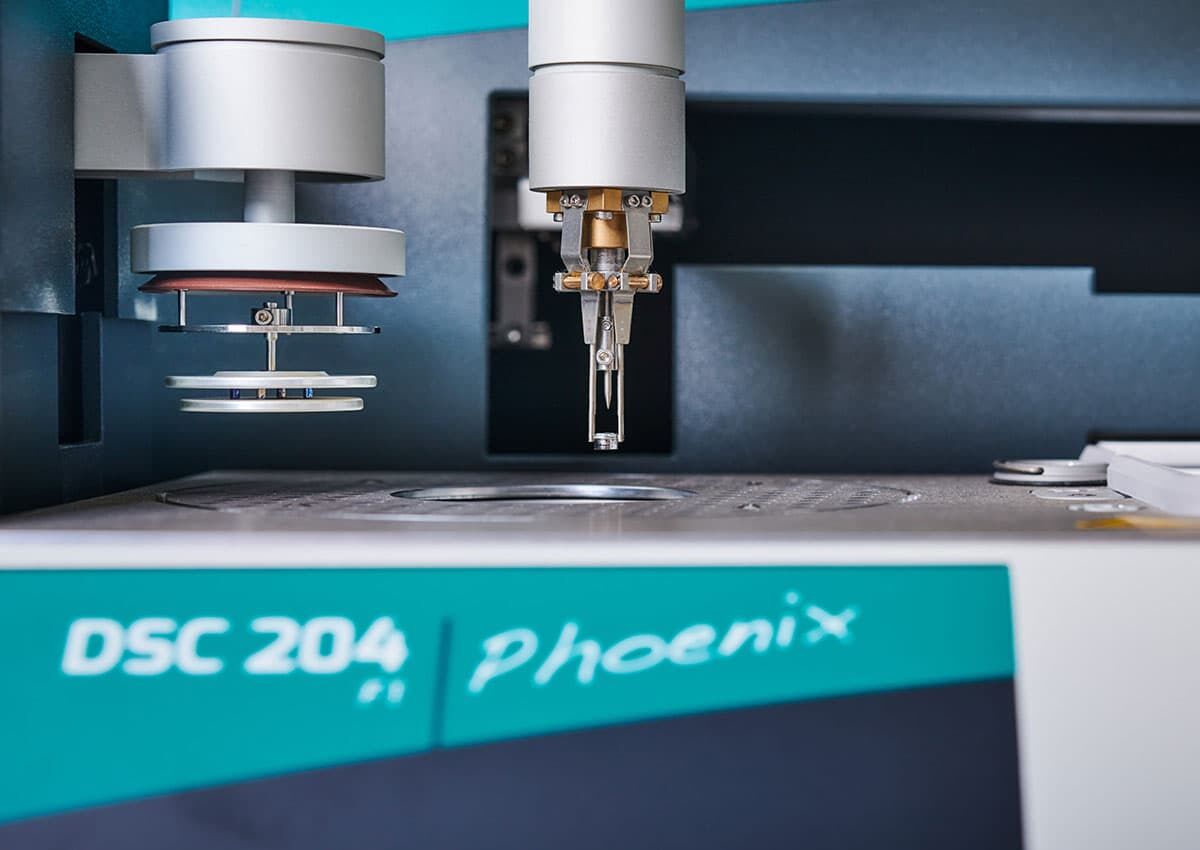
Differential Scanning Calorimetry, or DSC, is a thermal analysis method. It measures how much heat a sample absorbs or releases during heating, cooling, or under isothermal conditions. This allows for the determination of endothermic and exothermic processes, characteristic transition temperatures, and the associated enthalpies.
DSC detects thermal transitions and reactions, but not changes in mass. If temperature-dependent mass losses or gains are to be investigated as well, a thermogravimetric analysis (TGA) can be used as a supplement.
Which information does DSC provide?
DSC determines parameters for the characterisation of the thermal properties of a sample, e.g.
- The characteristic temperatures for the glass transition and melting area
- The crystallisation behaviour
- Enthalpies (heat of fusion, heat of crystallisation, heat of transformation and heat of reaction)
- Specific heat capacity
- Oxidation stability

These characteristics provide meaningful information about the sample, for instance:
- Degree of curing/curing state of adhesives
- Material identity and formulation components
- Modification and additional components
- Material composition
- Purity and contamination
- Thermal history
- Degree of crystallinity
- Phase transitions

What types of samples can be analyzed using DSC?
DSC is as versatile in its applications and the information it provides as it is comprehensive in its ability to analyze a wide variety of samples:
- Solids, such as polymers, metals, or building materials
- Powders
- Fibers
- Paste-like and viscous samples, such as creams or resins
- Liquids
Typical Applications for DSC Analysis
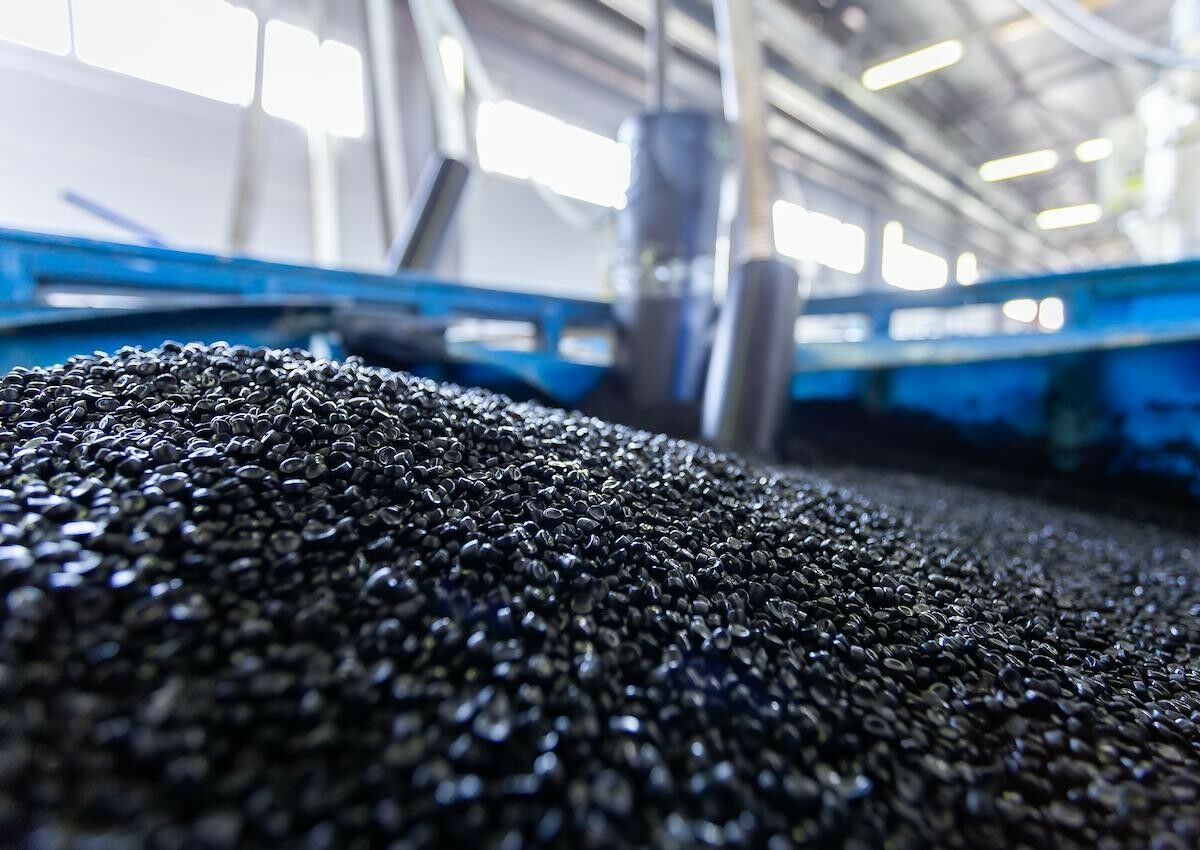
- Plastics and Polymer Analysis
- Material Development and Quality Assurance
- Incoming goods and comparative testing
- Damage and root cause analysis
- Analysis of adhesives, resins, and coatings
- Analysis of pharmaceutical and chemical products
- Food and packaging analysis
Differential scanning calorimetry (DSC)
at Quality Analysis
- Characterization of the thermal properties of polymers, plastics, and other materials
- Determination of glass transition temperature and melting point
- Measurement of enthalpies and degree of crystallinity
- Determination of specific heat capacity
- Investigation of oxidation stability
- Testing of curing behavior and degree of cure
- Tests in accordance with applicable standards and specific customer requirements
What are the measuring principles of differential scanning calorimetry (DSC)?
During differential scanning calorimetry, a crucible (container) with the sample and an empty crucible as a reference are subjected to the same temperature program. The DSC measurement is undertaken using a device that can heat or cool the samples to the required temperature and that monitors any temperature changes with very high precision. Due to the heat capacity of the sample, endothermic or exothermic processes or material state changes occur, that is phase transitions such as melting or sublimation. The heat flux characteristics of the sample can thus be measured as a function of the temperature.
Because thermal energy flows into or out of the related processes, there are temperature differences between the sample and the reference. This temperature difference is used as a measurement signal for the older differential thermal analysis (DTA). With the newer analytical method DSC, the heat flux derived from the temperature difference is used as the measurand.
There are two methods for determining the heat flux during DSC, heat flux differential scanning calorimetry and power compensating differential scanning calorimetry.
Heat flux differential scanning calorimetry
During heat flux DSC, the enthalpy changes (heat flux) in a sample are calculated by integrating the ΔT-TRef curve. For this purpose sample and reference must be in an oven on a disc-type measuring system with good thermal conductivity. Under the disc there are sensors that measure the heat that flows through the sample and reference. If the sample and reference emit the same heat to the disc, heat fluxes of the same magnitude are flowing through them. In this situation the heat flux differential is zero. However, if the sample changes, e.g. due to sublimation or melting, during the execution of the temperature program, the heat emitted also changes and there is a difference in the heat flux. The heat flux differential is always proportional to the temperature difference (ΦFP-ΦFR ~ ΔT, where ΦFP is the heat flux in the sample and ΦFR the heat flux in the reference and ΔT the difference in the temperature).
Power compensating differential scanning calorimetry
With this method the sample and reference are placed in two different, thermally insulated ovens. The ovens are adjusted such that the temperature is the same. It is now measured how much electrical energy is required to maintain the temperature in the ovens; the energy is acquired as a function of the temperature. Dynamic Differential Scanning Calorimetryis also known in English as Power Compensating DSC
Technical Specifications of our DSC System
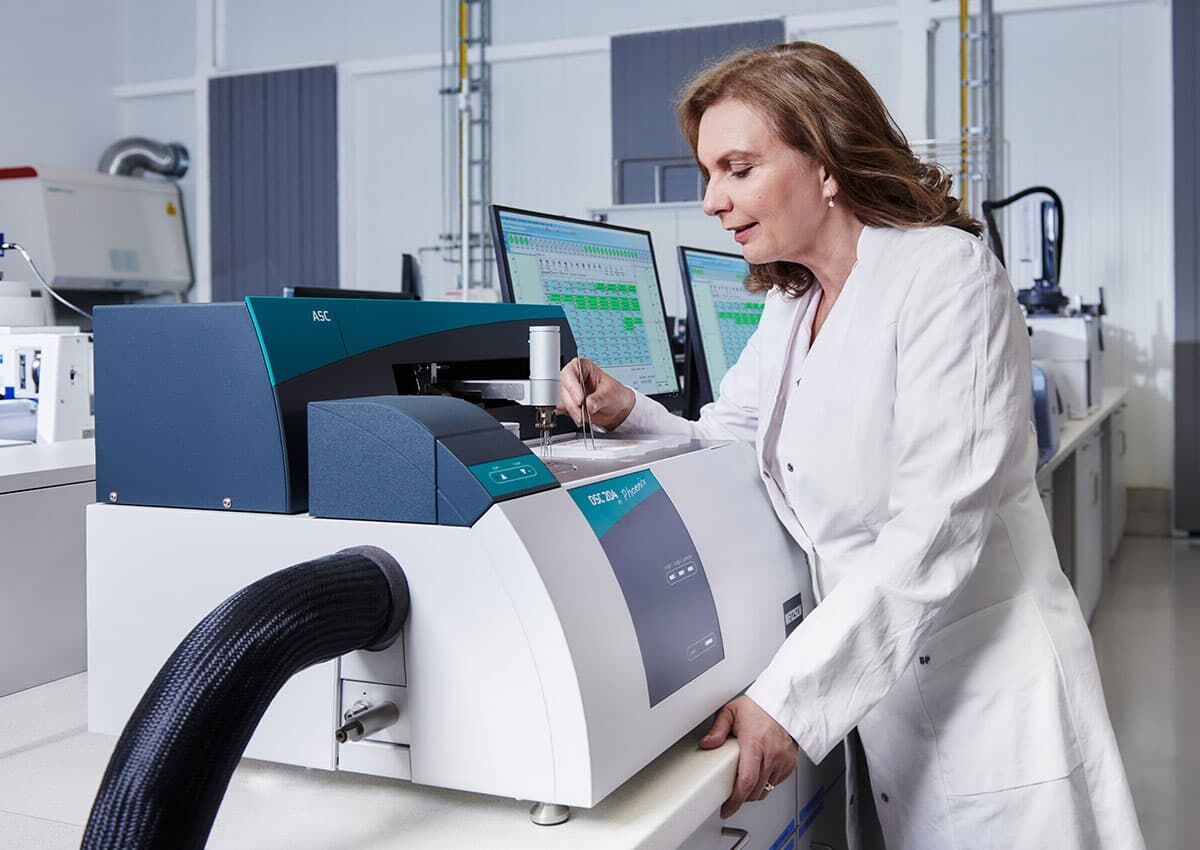
For thermal analysis, we use the high-performance NETZSCH DSC 204 F1 Phoenix in our chemical laboratory. The system is characterized by the following technical features:
- Temperature range from −180 °C to 700 °C
- Precise and reproducible determination of thermal properties
- High calorimetric sensitivity
- Interchangeable sensors for various measurement requirements
- High-sensitivity nickel-chromium-constantan thermal sensors
- Suitable for a wide range of thermal analysis tasks